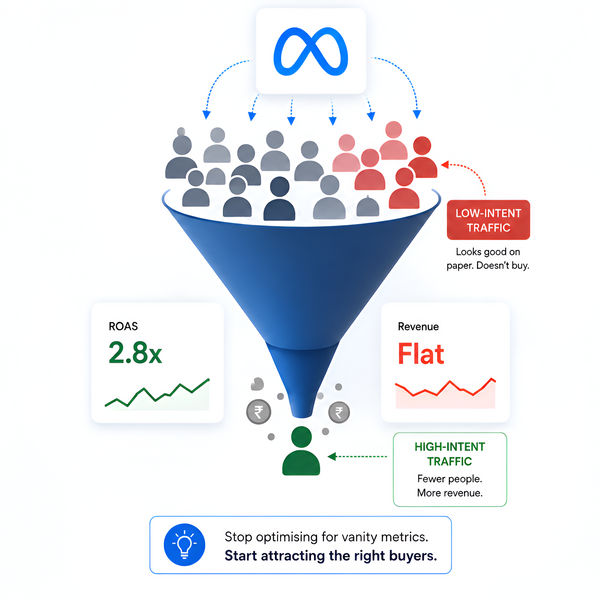
Most brands don't lose customers at checkout. They lose them the moment their store treats everyone the same. Every heatmap, every session recording, every A/B test you run has the same fatal flaw, the customer is already gone. Here's why that's costing you more than you think, and what to do while they're still on the page.
India's D2C brands typically convert between 0.5 and 1.5 percent of their traffic. Take 1.5 percent, which is actually generous. You're running a decent store with decent ads.
Your traffic, broken down
Monthly visitors
1,00,000
Conversion rate
1.5%
People who left
98,500
The brutal part: A 1% lift in conversion rate, on the same traffic, zero additional ad spend, adds ₹12,00,000 per month to a ₹1,200 AOV store. The revenue is sitting in the traffic you already bought. You're just not capturing it.
Traditional CRO Is Forensics. You Need a Paramedic.
You're using forensic tools and expecting real-time outcomes. By the time the insight reaches you, the person who triggered it is either your customer or your competitor's.
"Traditional CRO stacks are built to explain what went wrong, not to fix it in the moment."
The insight arriving in your inbox on Tuesday morning belongs to a shopper who visited on Saturday. That shopper made their decision and moved on. Your store had one window to respond, and it didn't.
What Actually Changes With Real-Time Personalization
The difference isn't just speed. It's a fundamentally different model of how a store responds to the people inside it.
| Dimension | Traditional CRO | Real-time personalization |
|---|---|---|
| When it acts | After the session ends | While the session is live |
| Who it optimizes for | Average of past visitors | This visitor, right now |
| Anonymous visitors | No profile, no action | Behaviour and context become intent |
| Product ordering | Static, rule-based | Reorders by inferred need |
| Time to results | Weeks for statistical significance | Adapts within the session |
What This Actually Looks Like in Practice
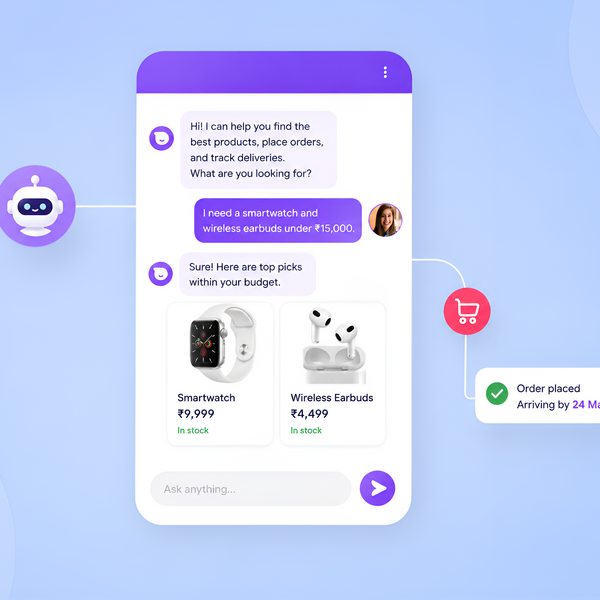
The challenge wasn't the catalog. It was that completely different people were landing on the same page and getting the same experience.

Most visitors were anonymous, which meant traditional personalization methods had nothing to work with. There was no purchase history, no account, no profile to build from. This is where Helium made a difference.
Instead of requiring users to sign in or share information, Helium read signals already present in every session, device type, traffic source, location, scrolling behaviour, time spent on page, clicks, and what users moved past without engaging. These signals were always there. The store simply wasn't responding to them.
Once the store started responding to these signals, the entire experience improved. The catalog stayed the same. The traffic stayed the same. What changed was the relevance of what each visitor saw.
+25%
Conversion rate
−30%
Bounce rate
+12%
Average order value
<2 min
Time to purchase
Even first-time visitors began behaving like informed buyers. Product pages felt more like conversations. Cart abandonment dropped as confidence improved. Instead of just showing products, the store started understanding why each person was there.

The Signals That Matter Most
AI personalization isn't magic. It works by reading signals that already exist in every session, and responding to them at the right moment. Here are the six that move the needle most.
Traffic source
Every visitor arrives with a different level of intent. Someone coming from retargeting already trusts you and is closer to buying, while someone from search is still figuring things out. Their mindset is set before they even land, so the experience should match that instead of treating everyone the same.
Scroll velocity
How fast someone scrolls says a lot. Quick scanning usually means casual browsing, while slower, deeper scrolling shows real interest. This is live intent in action, but most brands fail to respond to it.
PDP depth
Viewing one product suggests curiosity. Moving across multiple product pages in a short time signals active evaluation. At that stage, the goal should be to guide them toward strong options, not slow them down.
Bundle hover
When someone explores add-ons or bundles, they are already thinking beyond a single purchase. This is the right moment to highlight better combinations instead of leaving the decision to chance.
Return visitor status
A returning visitor doesn’t need to be convinced again, they need a nudge to convert. First-time visitors, on the other hand, need reassurance. Treating both the same often leads to missed opportunities.
Category behaviour
Jumping between categories usually means confusion, while going deep into one category shows clear intent. One needs clarity and direction, the other needs speed and ease. Most experiences fail to deliver either.
The Shift Worth Paying Attention To
For a long time, personalization was treated as a premium capability, something only companies like Flipkart and Amazon could afford to build in-house. That is starting to change.
As acquisition costs rise, the real advantage is no longer just bringing people in, but making more of the traffic you already have. Better discovery and higher conversion are becoming the real drivers of growth.
This is not just a passing trend, it comes down to unit economics. When customer acquisition costs are high and margins are tight, the real question is not whether personalization works, but whether your system can respond in real time or only analyze behaviour after the moment has passed.
If most visitors are leaving without buying, the question is not just why. It is what you are doing about it while they are still on your site.
"If most visitors are leaving without buying, the question is not just why. It is what you are doing about it while they are still on your site."
The brands that figure this out first will have a compounding advantage. Every session teaches the system something. Every improvement is permanent. The gap between a store that learns and one that doesn't widens with every week that passes.